
AI SEO + AEO tracking guide
AI Overview SEO rank tracking is now a real workflow, not a buzzword. In classic SEO, I used to ask one main question: where does the page rank in Google? In 2026, that is not enough. I also need to know whether Google shows an AI Overview, which sources are cited, whether the brand is mentioned, and whether those AI answers reduce or improve qualified traffic.
I reviewed the current Google guidance, official pricing pages, and the common gaps in existing AI Overview tracker roundups. The result is this practical guide for founders, SEO teams, agencies, SaaS marketers, ecommerce operators, and content teams that want a clean way to monitor rankings, citations, and brand mentions without wasting budget on the wrong AI visibility tool.
Short verdict
Start with Google Search Console and a small manual AI Overview tracking sheet, then buy a paid tracker only when you need prompt-level monitoring, competitor citations, share of voice, brand sentiment, and automated reporting. SE Ranking is the best practical add-on for SEO teams already using rank tracking. Semrush is strong if your team wants AI visibility inside a broader SEO suite. Ahrefs Brand Radar is useful for brand visibility and large-scale prompt data. OtterlyAI, Profound, Peec AI, ZipTie, and LLM Pulse are worth checking when AI search reporting itself is the main job.
Last updated: August 5, 2026. Pricing and product details can change quickly, especially prompt limits and AI engine coverage. I linked official sources where possible so you can verify before buying.
Answer-first summary
The best way to track AI Overview SEO rankings is to combine three layers: Google Search Console for official site-level Google data, a repeatable prompt sheet for free manual checks, and a paid AI visibility tracker when you need timestamped SERP snapshots, URL-level citations, country/device segmentation, competitor share of voice, and exports.
| Need | Best option | Why it matters |
|---|---|---|
| Free baseline | Google Search Console + manual checks | Shows official performance and teaches you which queries trigger AI Overviews. |
| SEO team workflow | SE Ranking or Semrush | Combines traditional rank tracking with AI visibility and reporting. |
| Brand visibility | Ahrefs Brand Radar, Profound, Peec AI, Omnia | Tracks mentions, citation sources, competitor visibility, and brand positioning. |
| Proof for clients | Tools with snapshots, exports, and URL-level citations | Prevents vague reporting and shows exactly what Google displayed. |
Editorial note: This guide follows the ReviewAIToolz review methodology and editorial policy. Tool facts are checked against public or official sources where possible, and hands-on testing is labelled only when it actually happened.
Who This Guide Is For
This guide is for anyone who is already doing SEO but now needs to report visibility across Google AI Overviews, Google AI Mode, ChatGPT-style answers, Perplexity, Gemini, Copilot, or other answer engines. It is especially useful if clients or stakeholders are asking: “Are we showing up in AI answers?”
Use it to combine classic rank tracking with AI Overview citations and source visibility.
Use it to build client reporting that explains visibility shifts instead of showing random screenshots.
Use it to find prompts where competitors are mentioned but your brand is missing.
What AI Overview SEO Rank Tracking Means
AI Overview SEO rank tracking means monitoring your visibility inside Google’s AI-generated search answers and comparing it with your traditional organic rankings. A good tracking setup answers five questions:
- Does the query trigger an AI Overview or AI Mode-style answer?
- Is my domain cited as a source?
- Is my brand mentioned, even if the URL is not cited?
- Which competitors and publications are cited instead?
- What happens to clicks, CTR, conversions, and assisted revenue after AI results appear?
This is why I do not like judging AI Overview visibility from one screenshot. AI answers can change by country, device, query wording, time, and testing. You need repeated checks, clean notes, and a simple reporting model.
What Most AI Overview Tracker Guides Miss
Most pages ranking for this topic explain AI Overview tracking as a tool list. That is useful, but it leaves a gap for users who want to know exactly how to track AIO presence, prove citations, compare classic rankings, and turn the data into SEO actions. A stronger guide needs a tracking framework, a free workflow, a paid-tool comparison, and a buyer scorecard in one place.
AI Overview tracking only makes sense when organic rank, indexing, internal links, and Search Console data are checked together.
Most small sites should learn from Search Console and manual checks before paying for enterprise AI search analytics.
Mentions are useful, but they are not enough. Track citations, source pages, volatility, traffic quality, and conversion impact.
Free AI Overview Tracking Workflow Before You Pay
If your website is new or your budget is tight, do not start by buying every AI visibility tracker. Start with a small repeatable workflow. This is the same order I would use for ReviewAIToolz or a client site.
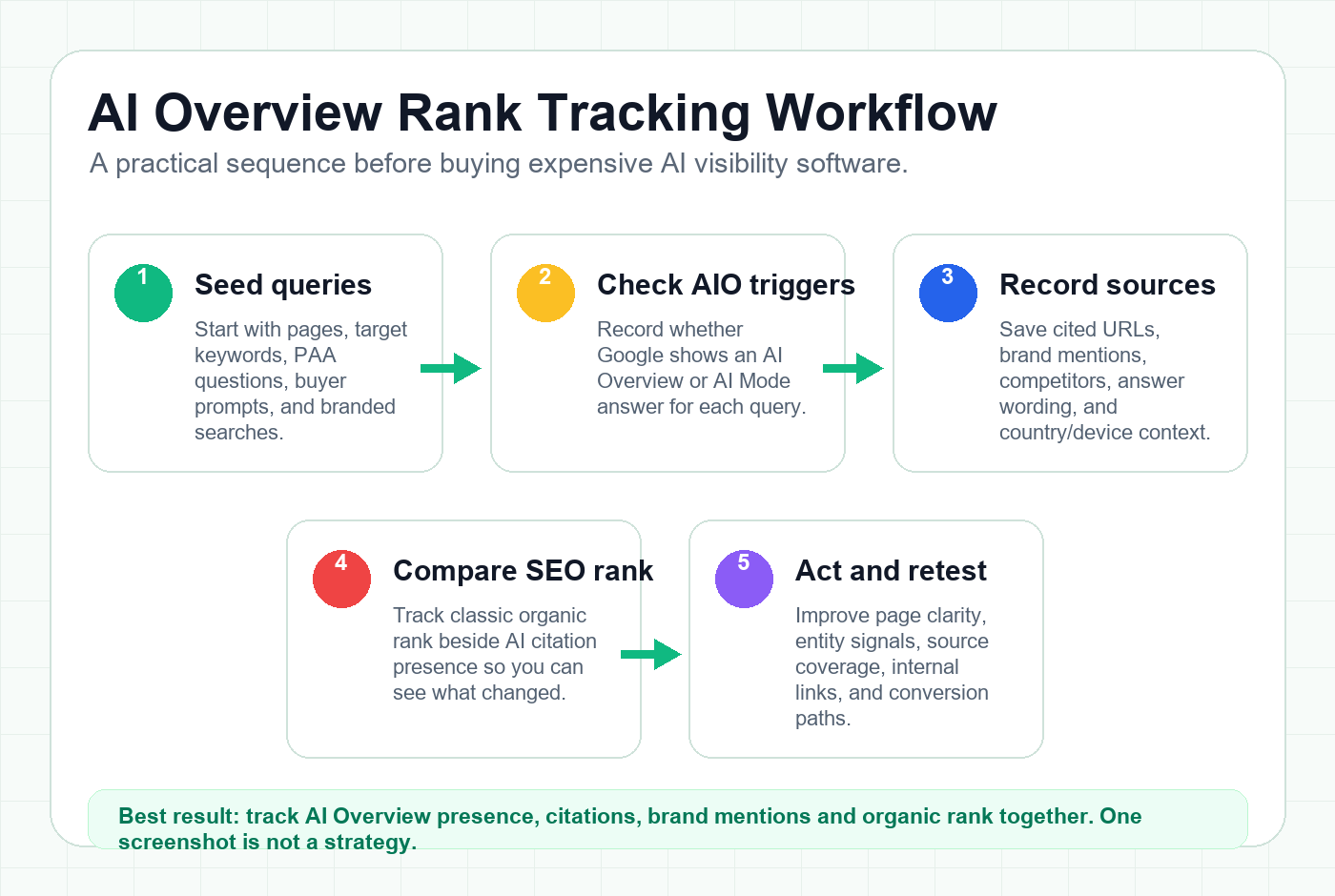
- Build a seed query set. Include primary keywords, long-tail buyer prompts, People Also Ask questions, branded terms, competitor comparisons, and “best tool” queries.
- Check whether AI Overviews appear. Record AIO trigger rate by country and device. Do not mix US desktop, Pakistan desktop, and mobile results in one messy report.
- Record cited sources. Save URLs, domains, brand mentions, answer wording, and whether your page was used as a supporting source.
- Compare with classic SEO rank. A page can rank in the top 3 and still not be cited in an AI Overview. That gap is an optimization opportunity.
- Improve and retest. Add clearer answer blocks, entity definitions, original examples, updated screenshots, internal links, FAQ coverage, and source-supported claims.
Metrics That Actually Matter
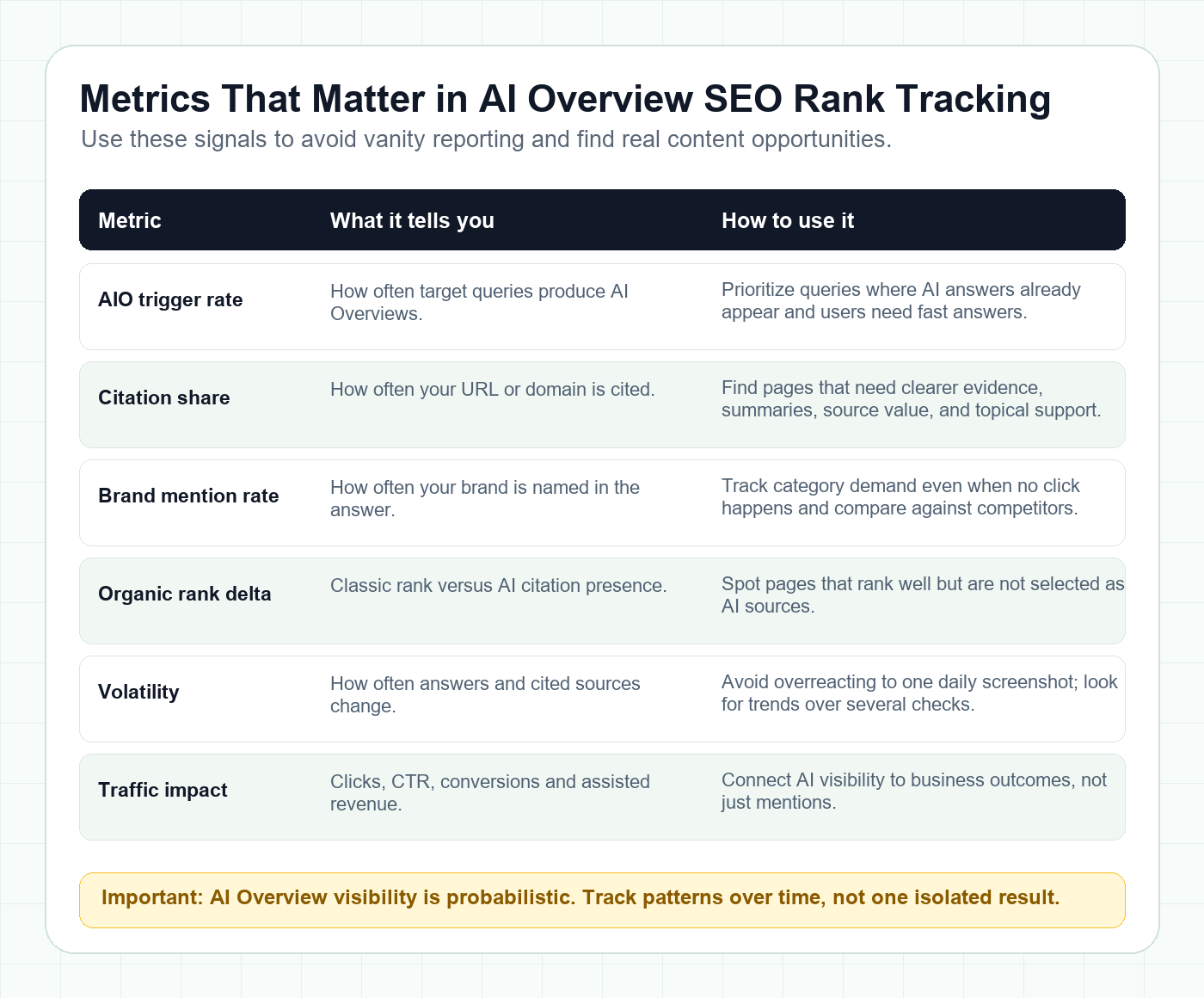
Traditional SEO rank is still important, but it is only one part of the picture. For AI Overview SEO, the goal is to understand whether your content becomes a source, a brand mention, or an influence point in the answer journey.
| Metric | Why it matters | What to do with it |
|---|---|---|
| AIO trigger rate | Shows how often your keywords produce AI Overviews. | Prioritize queries where AI answers already appear and buyer intent is clear. |
| Citation share | Shows how often your URL/domain is used as a source. | Improve pages that rank but are not cited. Add clearer summaries, evidence, and internal support. |
| Brand mention rate | Shows whether the answer names your brand. | Use it for SaaS, agencies, tools, local brands, and comparison queries where mention value matters. |
| Organic rank delta | Compares classic rank with AI source selection. | Find pages that need stronger topical authority or better answer formatting. |
| Volatility | Shows how often AI answers and sources change. | Report trends weekly or monthly instead of reacting to one daily result. |
| Traffic impact | Shows whether AI search visibility helps or hurts the business. | Connect Search Console, analytics, conversions, branded search, and assisted revenue. |
Best Free and Paid AI Overview SEO Rank Tracking Tools
The best tool depends on what you need to measure. If you only want official Google visibility, start with Search Console. If you need prompt-level tracking, competitors, citations, and exports, you will need a paid AI visibility tracker or an SEO suite with AI search features.
| Tool | Best for | AI Overview / AI search coverage | Public pricing signal | My verdict |
|---|---|---|---|---|
| Google Search Console | Official free baseline | Google AI feature performance reporting where available | Free | Use first, but add manual or paid tracking for prompt-level competitor analysis. |
| SE Ranking AI Search | SEO teams and agencies | AI Overviews, AI Mode, Perplexity, ChatGPT | AI Search add-on shown at $89/mo monthly or +$71.20/mo annual | Best practical SEO-suite choice if you want rank tracking and AI visibility together. |
| Omnia | Teams that want monitoring plus an action layer | ChatGPT, Google AI Overviews, Google AI Mode, Perplexity by default; more engines on request | Growth EUR 79/mo; Pro EUR 279/mo; Enterprise from EUR 499/mo on public pricing | Strong for teams that want AI visibility tracking to become content tasks, not only a dashboard. |
| Semrush AI Visibility Toolkit | Brands already using Semrush | Google AI Mode, ChatGPT prompt tracking, AI search audit, competitor research | $99/mo, no free trial on the public KB page | Strong if you need SEO + AI visibility in one Semrush workflow. |
| Ahrefs Brand Radar | Brand visibility and large prompt datasets | AI Overviews, AI Mode, ChatGPT, Perplexity, Gemini, Copilot, more | Brand Radar AI access starts at $199/mo per platform, all platforms $699/mo | Best for brand share of voice, citations, and large-scale visibility research. |
| OtterlyAI | Small teams and agencies | ChatGPT, Google AI Overviews, Perplexity, Copilot; extra engines by add-on | Lite $29/mo; Standard $189/mo | Good entry point for dedicated AI search visibility tracking. |
| Profound | Enterprise-style AI visibility reporting | ChatGPT on Starter; broader answer engines on higher plans | Starter $99/mo billed yearly; Growth $399/mo billed yearly | Strong for teams that need executive reporting, citations, and AI-sourced traffic attribution. |
| Peec AI | Marketing teams focused on AI search analytics | Visibility, position, sources, models, sentiment | Public site emphasizes trial / sales flow | Worth testing if brand sentiment and AI search analytics are your main job. |
| ZipTie | Budget AI Overviews + ChatGPT checks | Google AI Overviews, ChatGPT, Perplexity | Basic plan shown around $69/mo | Good lightweight option when you need AI search checks without a full enterprise stack. |
| LLM Pulse | Free and paid AI Overview checking research | Google AI Overviews and AI search visibility workflows | Verify current pricing on the official site | Useful when you want checker-style research and AI visibility education before building a full stack. |
1. Google Search Console: Best Free Baseline
Google Search Console should be the first place you check because it is the official source for Google Search performance. Google announced dedicated Search Generative AI performance reports in Search Console on June 3, 2026, including views for impressions, pages, countries, devices, and dates for generative AI features where the reports are available.
The limitation is important: Search Console is not a full AI Overview rank tracker. It will not replace a prompt-level tool that records exact AI answers, competitors, citations, and brand mentions across multiple AI engines. Use it as the source of truth for site-level Google performance, then combine it with manual checks or a paid tracker.
- Official Google data
- Free for verified site owners
- Useful for pages, countries, devices, and dates
- Generative AI reports are rolling out, not universal for every site
- No full competitor citation tracking
- No custom prompt monitoring workflow
2. SE Ranking AI Search: Best SEO Suite Add-On for Agencies
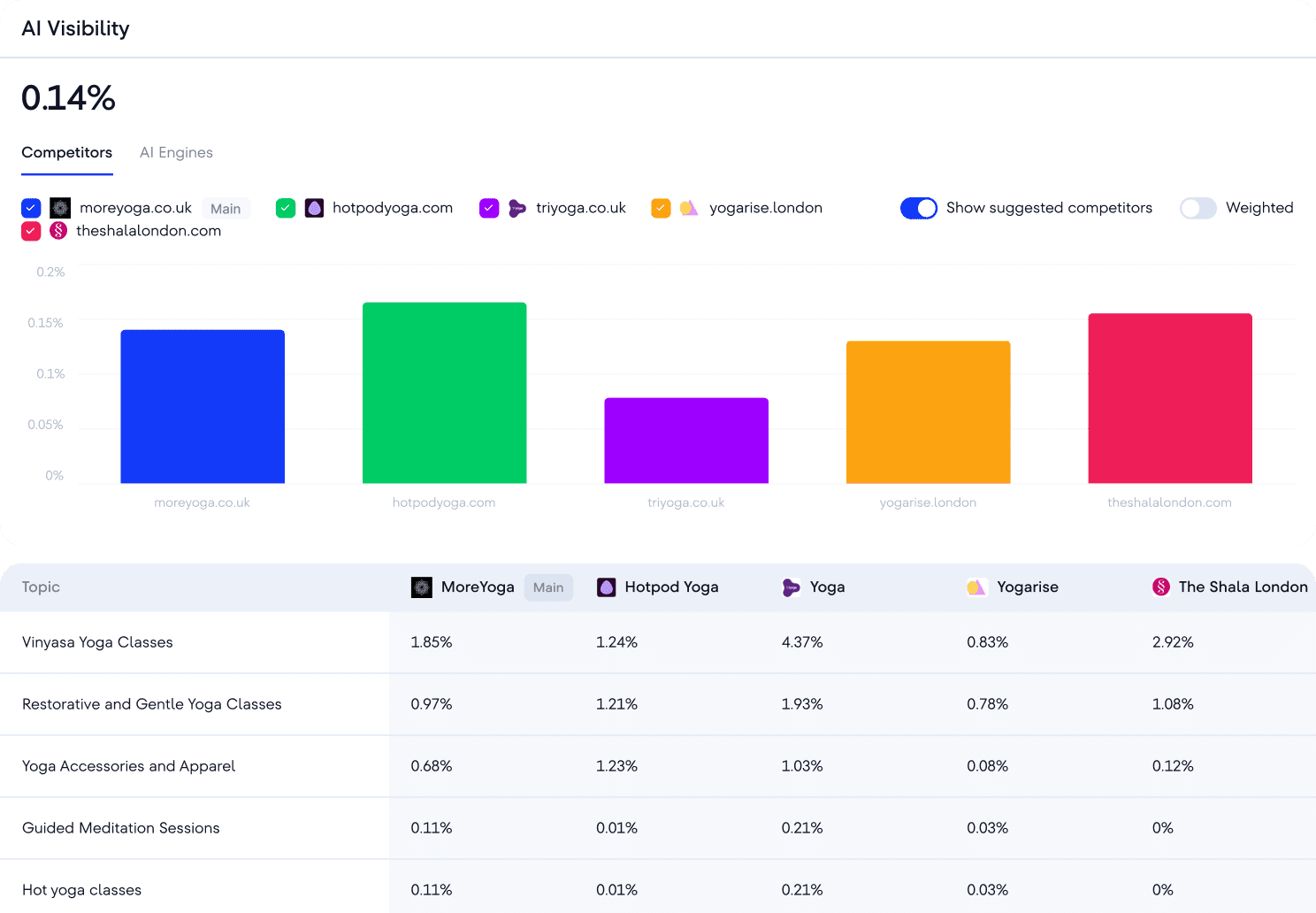
SE Ranking is a strong fit when you already care about rank tracking, keyword research, competitor research, audits, and reporting. Its AI Search add-on publicly lists AI Results Tracker coverage for AI Overviews, AI Mode, Perplexity, and ChatGPT, plus competitor research and a dashboard for mentions, citations, and sentiment trends.
I would shortlist it for agencies and small SEO teams that want a practical value-to-price option instead of a separate AI-only platform.
- Combines SEO rank tracking and AI visibility
- Useful for agencies managing multiple clients
- Clear public prompt limits and add-on pricing
- AI Search is an add-on, so total price depends on your base plan
- Prompt limits need planning if you track many markets
3. Omnia: Best When You Want an Action Layer, Not Only Tracking
Omnia deserves a place in this comparison because its public positioning is built around a real gap in AI Overview SEO rank tracking: monitoring alone is not enough. Teams also need to know what to publish, which sources to study, and which prompts deserve content updates.
On its pricing page, Omnia lists Growth at EUR 79 per month with up to 25 prompts, daily monitoring, ChatGPT, Google AI Overviews, Google AI Mode, and Perplexity enabled by default, plus citation monitoring and competitor benchmarking. Pro expands to 100 prompts and adds exports and sentiment analysis.
- Clear action-layer positioning
- Daily monitoring and citation monitoring
- Useful for lean teams that need content tasks from visibility data
- Prompt limits may be tight for large SEO portfolios
- Best value depends on whether you will actually use the recommendations
- Still needs to be paired with Search Console and classic SEO metrics
4. Semrush AI Visibility Toolkit: Best for Semrush Users
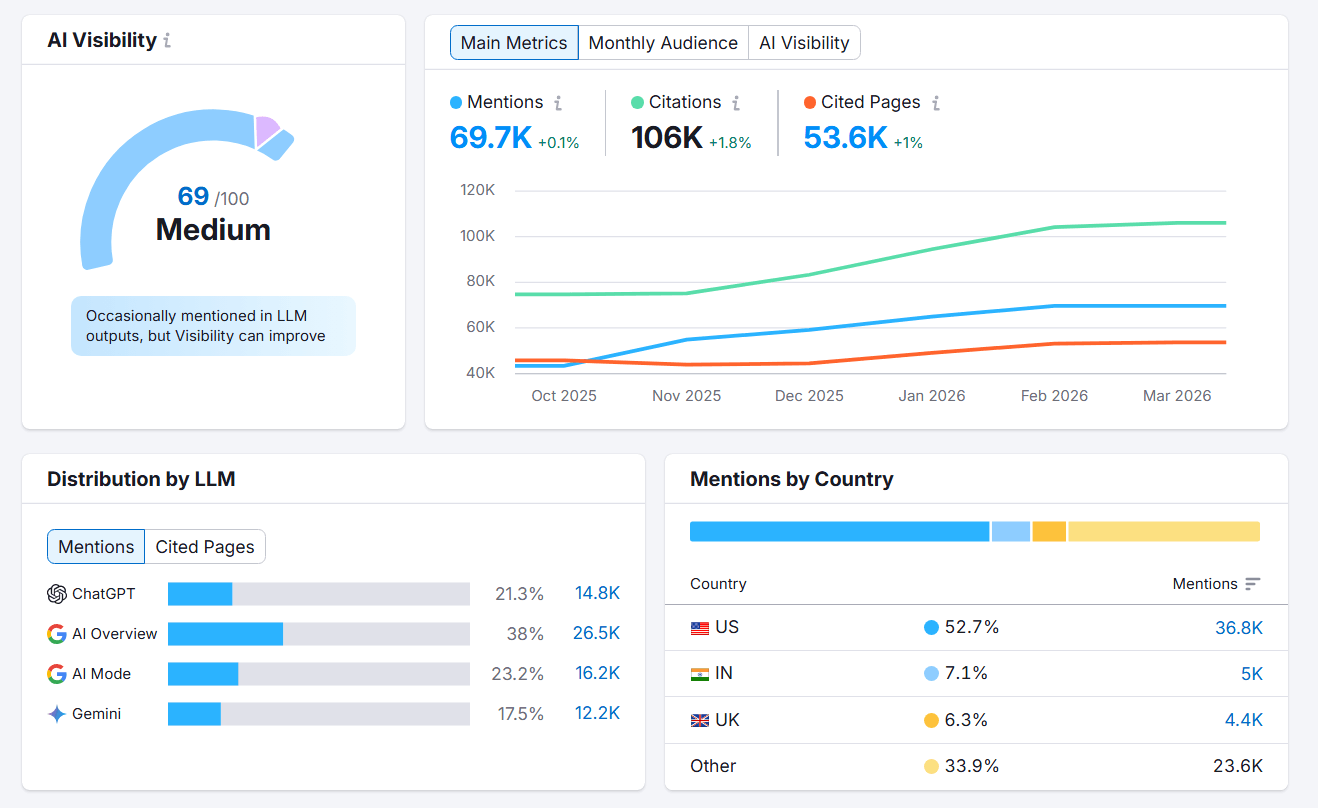
Semrush AI Visibility Toolkit is built around prompt research, competitor research, brand performance, prompt tracking, and AI search site audit checks. The official KB lists prompt tracking for platforms like Google AI Mode and ChatGPT, plus an AI Search Site Audit that flags blockers that could prevent AI bots from crawling content.
At the time I checked, the public KB listed the AI Visibility Toolkit at $99 per month with no free trial and 25 prompts for Prompt Tracking. That makes it a sensible add-on for teams already inside Semrush, but small websites should still validate their prompt set before paying.
- Strong SEO ecosystem
- Prompt research and brand performance reports
- AI Search Site Audit is useful for technical blockers
- Prompt limit may feel tight for multi-market agencies
- No free trial listed for the AI toolkit
- Best value if you already use Semrush
5. Ahrefs Brand Radar: Best for Brand Visibility Research
Ahrefs Brand Radar is especially interesting for teams that care about share of voice, brand mentions, cited domains, and prompt-level opportunity discovery across AI answers. Ahrefs explains that its data comes from People Also Ask questions from its keyword index, which are entered into AI chatbot interfaces using default models.
The key advantage is scale. If your brand competes in a crowded SaaS, ecommerce, finance, or B2B category, Brand Radar can help you see which competitors and publications are being surfaced by AI systems.
- Useful for brand visibility and competitor benchmarks
- Strong citation and source analysis
- Fits teams already using Ahrefs for SEO
- Standalone platform access is expensive for small sites
- AI chatbot freshness can be slower than daily rank checks
- Needs clear prompt strategy to avoid noisy reporting
6. OtterlyAI: Best Dedicated Tracker for Small Teams
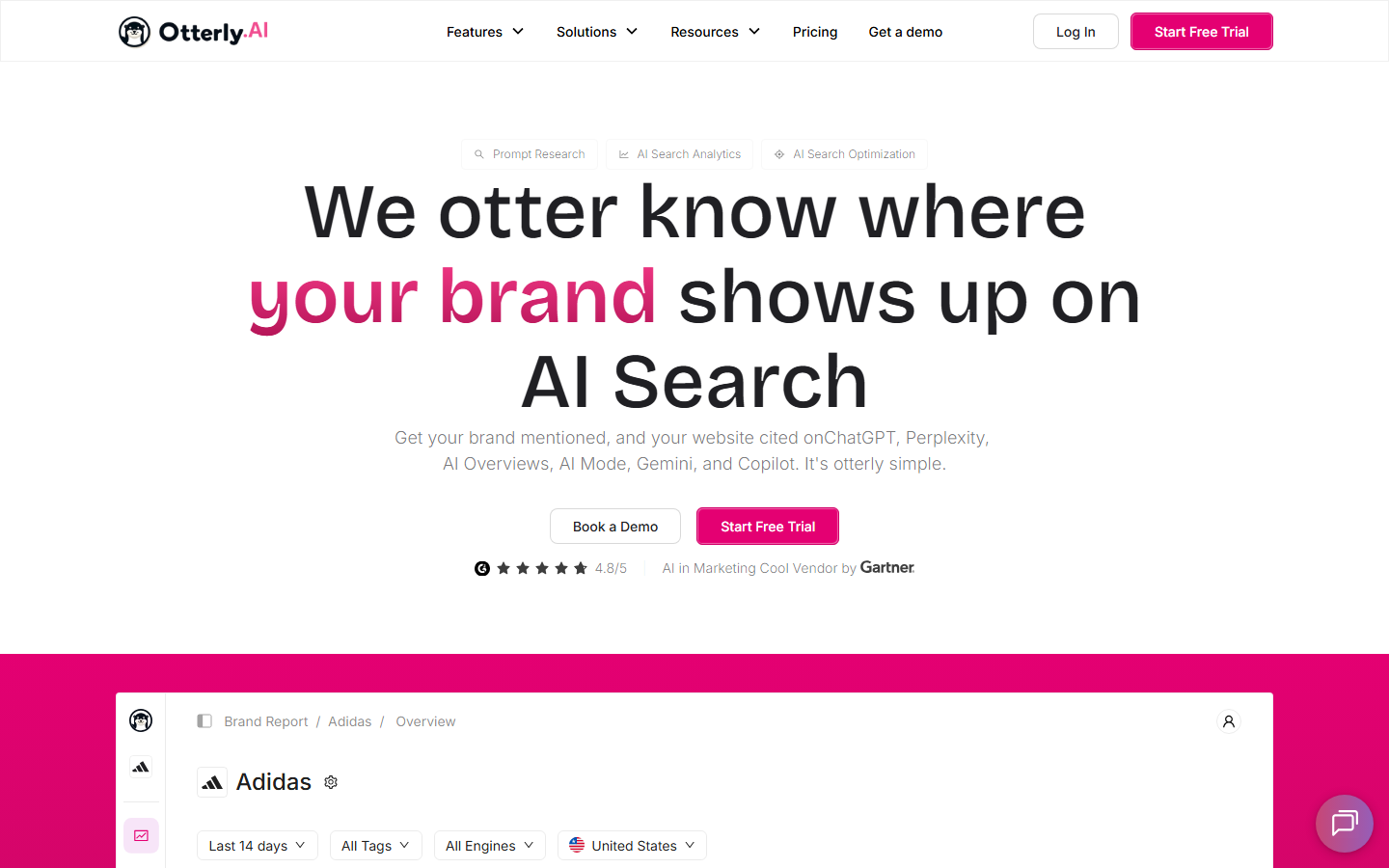
OtterlyAI is one of the easier dedicated tools to understand. Its public pricing page lists a Lite plan at $29 per month with 15 search prompts and tracking for ChatGPT, Google AI Overviews, Perplexity, and Microsoft Copilot. Standard and Premium plans increase prompt limits and reporting capacity.
I would test OtterlyAI when you want a focused AI visibility tracker without buying a heavyweight SEO suite first.
- Accessible entry price
- Good for small teams learning AI search reporting
- Tracks multiple AI search engines on public plans
- 15 prompts on Lite is limited
- Some engines require add-ons
- SEO keyword research still needs another tool
7. Profound: Best for Enterprise-Style AI Visibility Reporting
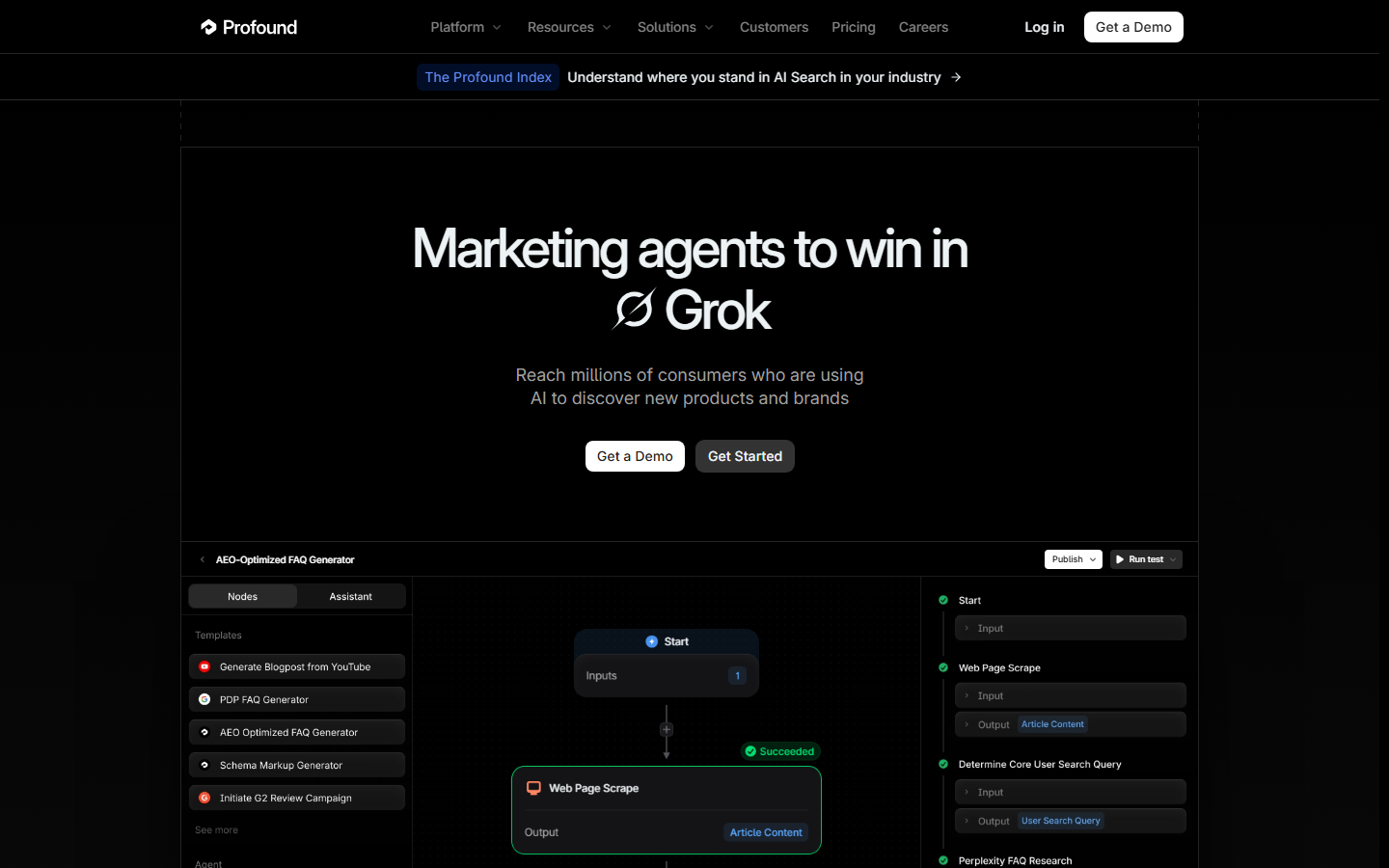
Profound is positioned for teams that need to monitor and understand how brands appear in AI answer engines. Its public pricing page lists Starter at $99 per month billed yearly with ChatGPT tracking only and 50 prompts, while Growth expands to more answer engines and 100 unique prompts.
The reason I include Profound is not because every small site needs it. Most do not. I include it because serious brands will eventually need AI-sourced traffic attribution, citation monitoring, and competitor visibility in a board-friendly format.
- Strong fit for larger brands and teams
- Useful for citations, visibility, and attribution
- Broad engine support on higher plans
- Starter is limited to ChatGPT tracking
- Annual billing may be too heavy for small sites
- Overkill if you only need simple AIO checks
8. Peec AI: Best for Marketing Teams Tracking Visibility, Position, and Sentiment
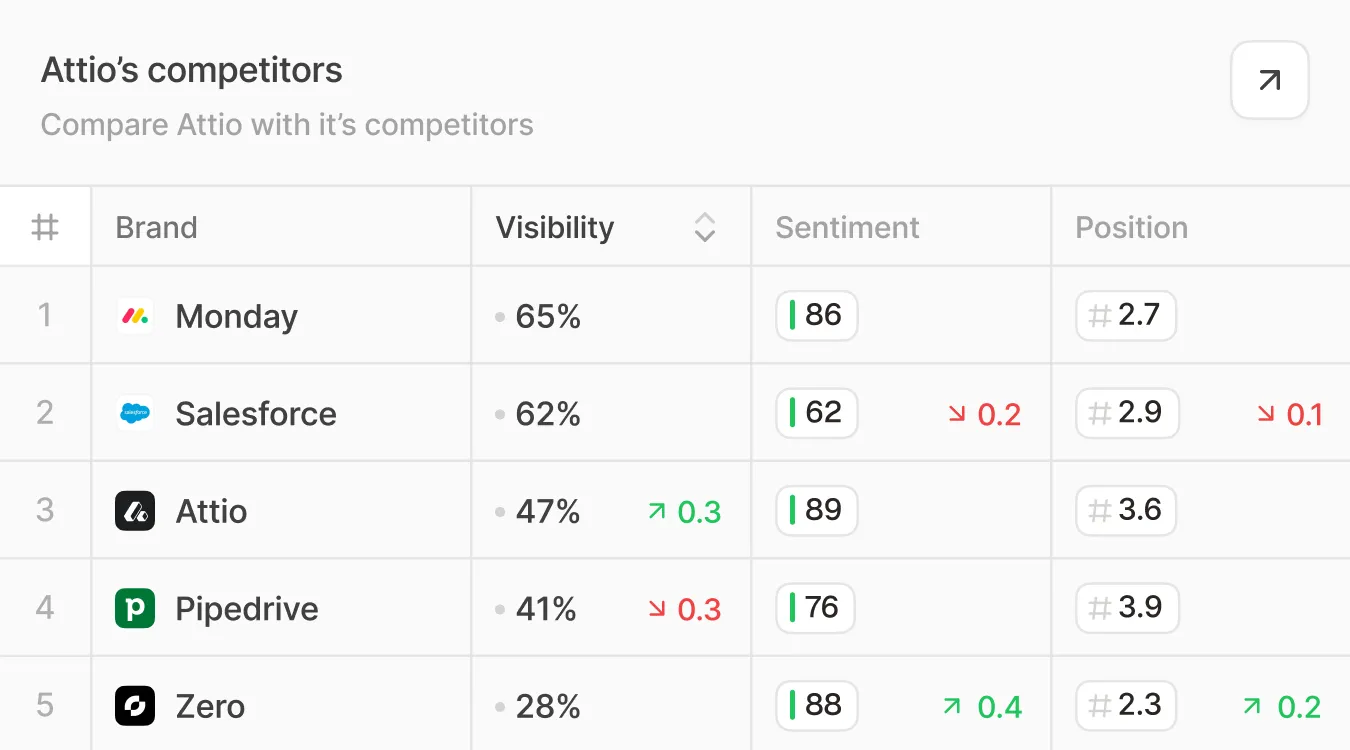
Peec AI describes itself as AI search analytics for marketing teams and focuses on visibility, position, sources, models, and sentiment. That makes it useful when your question is not only “are we cited?” but also “how do AI systems describe us compared with competitors?”
I would evaluate Peec AI for SaaS, B2B, and category-leading brands where narrative and sentiment matter. If you only need a few Google AI Overview checks, start cheaper.
- Strong brand and sentiment angle
- Useful dashboard language for marketing teams
- Good fit for AI search analytics beyond rankings
- Pricing needs direct verification on the current plan page or sales flow
- May be more than a small content site needs
9. ZipTie: Best Lightweight AI Search Checker
ZipTie is worth considering when you want AI search checks for Google AI Overviews, ChatGPT, and Perplexity without jumping straight into a large enterprise tool. Its public page shows a Basic plan around $69 per month with AI search checks, plus higher plans with more checks and content optimization limits.
- Focused AI search checker
- Good for smaller prompt sets
- Covers AIO, ChatGPT, and Perplexity
- Not a replacement for full SEO suites
- Plan limits matter if you track many keywords or clients
10. LLM Pulse: Best for AI Overview Checker Research
LLM Pulse is worth checking when your immediate goal is to understand Google AI Overview checker workflows, AI visibility monitoring language, and how dedicated checker tools frame the market. I would not treat it as a replacement for Search Console or a full SEO suite, but it can help teams compare the difference between a one-off AI Overview checker and ongoing AI rank tracking.
- Useful for AI Overview checker intent
- Helpful educational angle for new GEO teams
- Good comparison point against broader AI rank trackers
- Confirm current plan limits and pricing before relying on it
- May need another tool for traditional SEO rank tracking
AI Overview Tracker Buying Scorecard
If a tool wants to be trusted for AI Overview SEO rank tracking, I would score it against these signals before paying. This makes the article more useful than a simple ?best tools? list because it tells you how to judge any new tracker that appears later.
| Scorecard item | What a good tool should show | Why it helps you win AI Overviews |
|---|---|---|
| Timestamped SERP snapshots | Saved screenshot or HTML for the exact query, country, device, and date. | Gives proof when AI answers change or clients ask what Google displayed. |
| URL-level citations | Exact cited URLs, not only domain names or generic visibility scores. | Shows which page format and source type Google trusted. |
| Country and device controls | Separate desktop/mobile and US/UK/EU or target-market tracking. | Prevents false confidence from one location. |
| Prompt reruns and volatility | Daily or weekly checks with changed-answer flags. | Helps you report patterns instead of reacting to one result. |
| Competitor overlap | Which competitors, publishers, forums, docs, and review pages were cited. | Turns missing citations into a content and digital PR roadmap. |
| Action layer | Recommendations, content briefs, internal-link tasks, or source-gap analysis. | Moves the team from ?we are missing? to ?here is what to improve.? |
| Export/API access | CSV, API, Looker Studio, or report sharing. | Lets you connect AI visibility with conversions, branded search, and revenue. |
Which AI Overview Rank Tracker Should You Choose?
| Your situation | Best starting choice | Why |
|---|---|---|
| New website or limited budget | Google Search Console + manual sheet | Learn your AIO trigger rate before paying for software. |
| Small SEO team | SE Ranking AI Search or OtterlyAI | Good balance of cost, prompt tracking, and workflow clarity. |
| Already using Semrush | Semrush AI Visibility Toolkit | Keeps AI visibility inside your existing SEO operating system. |
| Already using Ahrefs heavily | Ahrefs Brand Radar | Strong for citation, competitor, and brand visibility research. |
| Enterprise or funded SaaS | Profound or Peec AI | Better for executive dashboards, sentiment, attribution, and multi-engine visibility. |
| Need quick AIO checks | ZipTie or LLM Pulse-style checkers | Useful for lighter monitoring without a full suite. |
My 30-Day AI Overview Tracking Plan
If I were starting from zero, I would not try to track hundreds of keywords on day one. I would build a controlled 30-day test.
- Day 1 to 3: Choose 30 prompts: 10 money keywords, 10 question keywords, 5 branded/competitor prompts, and 5 comparison prompts.
- Day 4 to 7: Check Google Search Console, manual Google results, and your existing rank tracker. Mark AIO trigger, cited URLs, brand mention, and classic rank.
- Week 2: Improve pages that rank but are not cited. Add concise definitions, comparison tables, FAQs, author signals, source links, and stronger internal links.
- Week 3: Retest the same prompt set. Do not change all prompts or you will lose the baseline.
- Week 4: Decide whether paid tracking is justified. If you need client dashboards, competitor monitoring, exports, or multi-engine coverage, buy a focused tool.
Common Mistakes to Avoid
- Tracking only broad head keywords. AI answers often appear on question-led, comparison, and problem-solving queries.
- Ignoring brand mentions. A buyer may see your brand in the answer without clicking immediately. That still matters.
- Confusing AI visibility with traffic growth. Track clicks, CTR, conversions, branded search, and assisted pipeline beside mentions.
- Changing the prompt set every week. You need a stable baseline before you can report improvement.
- Trusting one location or one device. AI Overview visibility can change by market and device.
- Buying a tool before defining the report. First decide what you need to report: citations, brand mentions, competitors, pages, or revenue impact.
How to Improve Your Chance of Being Cited
There is no guaranteed trick for getting cited in AI Overviews, and I would avoid anyone promising one. Google says there are no extra technical requirements or special schema needed for AI features. The fundamentals still matter: crawlability, indexability, internal links, page experience, useful visible text, high-quality media, and structured data that matches what users can see.
For AEO and GEO, I would add these content improvements:
- Put a concise direct answer near the top of the page.
- Use clear H2s that match real user questions.
- Add comparison tables where buyers need choices.
- Include original testing notes, screenshots, examples, and limitations.
- Build internal links from supporting pages to the target page.
- Refresh pricing, screenshots, and feature claims regularly.
- Make the author, brand, contact page, and editorial process easy to verify.
For a deeper foundation, read our guide to Answer Engine Optimization and the tool roundup on AI tools for SEO and AEO. If you are comparing SEO platforms first, use our AI SEO tools comparison and the AI SEO category hub.
Want Your AI SEO Tool Reviewed?
If you run an AI SEO, AEO, GEO, rank tracking, or AI visibility platform, you can submit your tool for editorial review. ReviewAIToolz focuses on practical use cases, pricing clarity, screenshots, pros and cons, and buyer-safe recommendations.
Sources Checked
- Google Search Central: Search Generative AI performance reports
- Google Search Central: AI features and your website
- SE Ranking pricing and AI Search add-on
- Semrush AI Visibility Toolkit KB
- Ahrefs Brand Radar documentation
- OtterlyAI pricing
- Profound pricing
- Peec AI
- ZipTie
- Omnia pricing
- LLM Pulse
FAQs About AI Overview SEO Rank Tracking
What is AI Overview SEO rank tracking?
AI Overview SEO rank tracking is the process of monitoring whether your pages, brand, or competitors appear inside Google AI Overviews and related AI search features. A useful workflow tracks AI Overview presence, cited URLs, brand mentions, classic organic rank, country/device context, volatility, and traffic impact together.
Can Google Search Console track AI Overview performance?
Yes, Google has introduced Search Generative AI performance reports in Search Console for a subset of websites, and Google also says AI features are included in overall Search Console performance reporting. Search Console is useful for official site-level visibility, but it is not a full prompt-level competitor and citation tracker.
What is the best free way to check AI Overview rankings?
Start with Google Search Console, then manually check a small set of priority queries in a neutral browser and record whether an AI Overview appears, which URLs are cited, whether your brand is mentioned, and what changed after content updates. This free method is slow, but it teaches you what matters before you buy a paid tracker.
Which paid tools track AI Overviews, citations, and brand mentions?
SE Ranking, Semrush, Ahrefs Brand Radar, OtterlyAI, Profound, Peec AI, ZipTie, and LLM Pulse are relevant options to evaluate. Their coverage differs by plan, prompt limit, supported AI engines, countries, export options, and whether they focus on Google AI Overviews only or broader AI search visibility.
Is AI Overview rank tracking completely accurate?
No AI Overview rank tracker is perfect because AI search results can vary by location, device, query wording, personalization, time, model changes, and Google testing. The safest approach is to track trends across repeated checks instead of making decisions from one screenshot.
How often should I track AI Overview SEO visibility?
For active SEO campaigns, weekly tracking is enough for most sites. Agencies, enterprise teams, and fast-moving SERPs may prefer daily tracking. The important part is to keep a consistent prompt set, country, device, and reporting method.
Do traditional SEO rankings still matter if AI Overviews appear?
Yes. Classic rankings still matter because Google needs crawlable, indexable, useful pages to select from, and users still click regular organic results. AI Overview tracking should sit beside traditional rank tracking, not replace it.
Do I need special schema or llms.txt to appear in AI Overviews?
Google says there are no special technical requirements, no special schema, and no new machine-readable AI file required for AI Overviews or AI Mode. Focus first on crawlability, indexability, helpful content, internal links, page experience, visible text, high-quality media, and structured data that matches the visible page.
Found something wrong or outdated? Report an issue. Want us to cover something? Suggest a topic.
Comments