
I have been testing and analyzing how businesses can show up inside AI-generated answers, and in this guide I am breaking down what I have learned about AEO, or Answer Engine Optimization. If you run a business, manage SEO for clients, or want your brand to be visible in ChatGPT-style answers, Google AI Overviews, Perplexity, and other AI search experiences, this is the practical framework I would start with.
Direct answer
Answer Engine Optimization is the process of making your content, brand, and expertise easy for answer engines to understand, trust, summarize, and cite. I do not treat AEO as a replacement for SEO. I treat it as the next layer on top of strong SEO: clear answers, strong entities, question coverage, reliable sources, structured formatting, and real authority signals.
My view is simple: AI visibility is not won by one trick. It comes from becoming the source that search engines, AI systems, and real users can verify. That means the page still needs to be useful, crawlable, clear, and worth referencing.
Editorial note: This guide follows the ReviewAIToolz review methodology and editorial policy. Tool facts are checked against public or official sources where possible, and hands-on testing is labelled only when it actually happened.
What AEO Actually Means
AEO stands for Answer Engine Optimization. At its core, it is about getting your brand, page, product, or expertise mentioned inside AI-generated answers. These answers can appear in Google AI Overviews, AI Mode-style search experiences, ChatGPT, Perplexity, Gemini, Copilot, and other tools where the user gets an answer before they click a traditional blue link.
In classic SEO, I usually ask: can this page rank, earn clicks, and satisfy search intent? In AEO, I add another question: can an answer engine confidently extract the answer, understand the entity behind it, and cite or mention it without confusion?
That second question changes how I write, structure, and support content. I still care about keyword research, internal links, technical SEO, and page quality. But I also care about question phrasing, source clarity, brand mentions, topical authority, structured snippets, FAQs, comparison tables, and off-site trust.
Why I Still Start With SEO Before AEO
AEO is not a shortcut around SEO. Google’s own guidance says the best practices for SEO remain relevant for AI features in Search, and pages generally need to be indexed and eligible for normal Search before they can appear as supporting links in AI experiences. That is why I do not start with tricks. I start with the basics.
- The page should target a real user problem, not only a keyword.
- The answer should be clear enough that a person can understand it quickly.
- The site should be crawlable and internally linked.
- The page should include visible text, not important information trapped only inside images.
- The content should show experience, expertise, accuracy, and a reason to trust the author.
This is also why I still pay attention to Google. According to StatCounter’s worldwide search engine data, Google still accounts for about nine-tenths of global search activity. ChatGPT and Perplexity matter, but Google AI Overviews matter a lot because they sit inside the search behavior people already have.
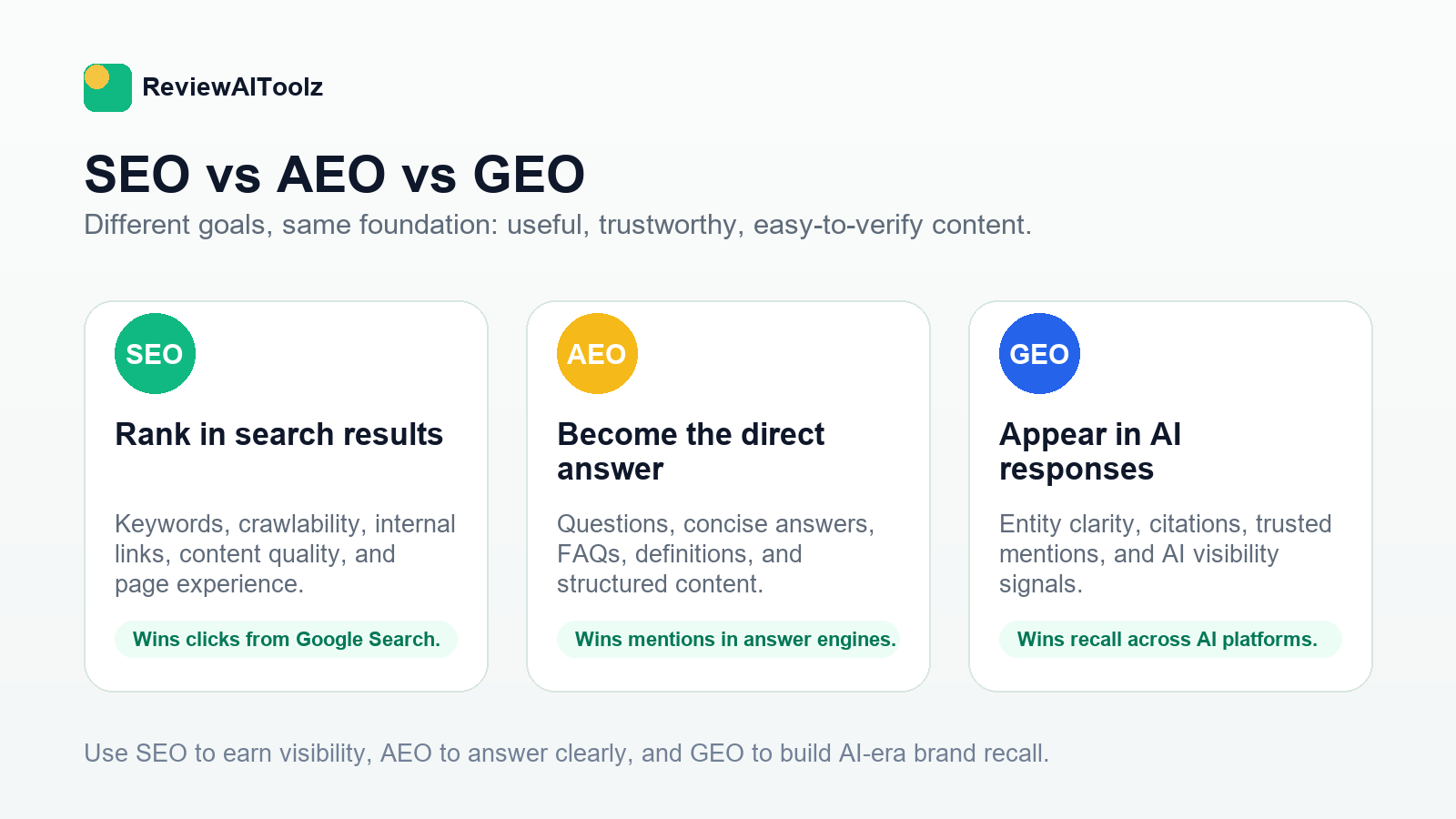
AEO vs SEO vs GEO
These terms overlap, but I separate them like this when I plan content:
| Term | What I optimize for | What success looks like |
|---|---|---|
| SEO | Search rankings, organic clicks, crawlability, topical relevance, internal links, user satisfaction. | The page ranks, earns impressions, gets clicks, and converts qualified visitors. |
| AEO | Direct answers, question coverage, concise definitions, FAQ blocks, tables, citations, entity clarity. | The brand or page is mentioned, cited, summarized, or used as a source inside answer experiences. |
| GEO | Visibility inside generative search and large language model answers across different platforms. | The brand appears across AI search tools with accurate positioning and useful context. |
I use all three together. SEO gives the page a foundation. AEO makes the answer easy to extract. GEO looks at the broader generative search environment where the brand may be mentioned even when a classic ranking report does not show the full story.
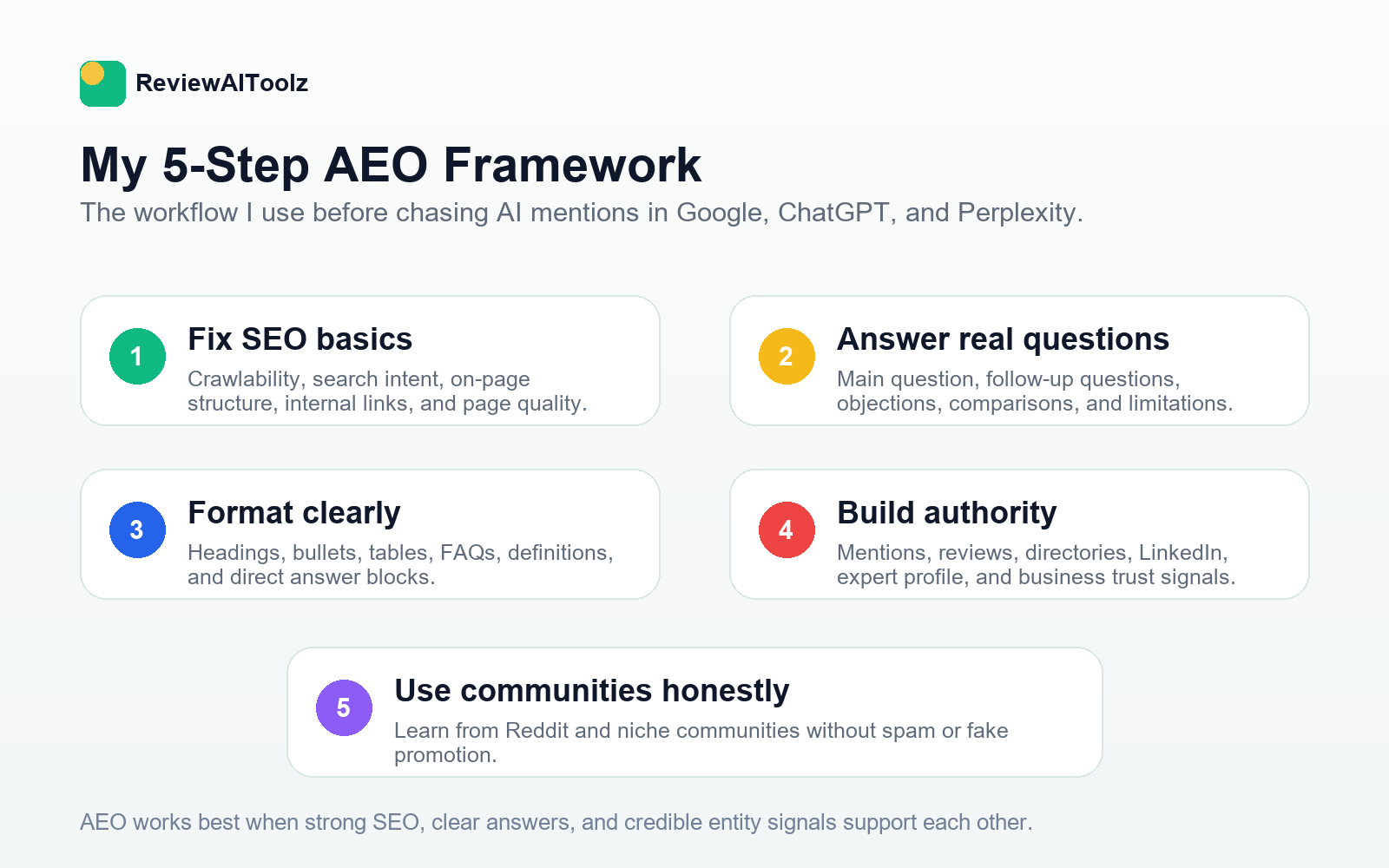
My 5-Step AEO Framework
This is the exact order I use when I am improving a page for answer engine visibility.
1. I fix the SEO foundation first
Before I expect any AI system to trust a page, I make sure the page deserves to exist in search. I check the search intent, title, headings, crawlability, internal links, page speed, mobile readability, and whether the page gives a complete answer.
If a page has thin content, broken formatting, no internal links, and no clear author or source signals, AEO will not save it. I would rather publish one page that fully answers a problem than publish ten pages that repeat the same generic advice.
2. I optimize for questions, not only keywords
AI search users ask questions in natural language. They do not always search like an SEO tool suggests. Instead of only targeting a phrase like “answer engine optimization,” I map the follow-up questions a real person would ask:
- What is AEO?
- Is AEO different from SEO?
- How do I get mentioned in Google AI Overviews?
- Can ChatGPT cite my website?
- What content format works best for AI search?
- How do I track AI visibility?
Then I answer those questions directly and expand with examples, limitations, and next steps. That structure helps both humans and AI systems understand the page faster.
3. I format content so AI and humans can read it
Formatting matters because answer engines need to identify clean information. I use clear H2 and H3 headings, short paragraphs, bullet lists, tables, definitions, FAQs, and supporting images. I avoid hiding the main answer inside long blocks of text.
I also use structured data when it matches the visible content. Google explains that structured data helps Search understand page information, but it should match what users can actually see. So I use Article schema for articles and FAQ schema only when the FAQs are visible on the page.
4. I build authority beyond the page
AEO is not only on-page formatting. AI systems care about confidence. If the web does not understand who you are, what your brand does, and why your page should be trusted, your content has a weaker chance of being selected.
For a business, I look for authority signals like consistent brand profiles, relevant directory listings, industry mentions, expert bylines, product reviews, helpful tutorials, LinkedIn activity, and citations from trusted pages. For a software company, this is where a strong tool listing in a focused AI directory can help build entity clarity and discovery.
5. I use Reddit and communities carefully
Reddit and niche communities are useful because they show real language, real complaints, and real questions. I do not recommend spamming communities with links. That usually damages trust. Instead, I use Reddit to understand what people are asking, what they dislike, which comparisons matter, and what objections a page should answer.
When I participate, I try to be transparent and genuinely helpful. Community trust is slow, but it can become a strong signal because AI systems often surface real discussions when users ask product, comparison, and problem-solving questions.
How I Format an AEO-Friendly Article
When I turn a topic into an AEO-friendly article, I try to make the page easy to scan and easy to verify. This is the structure I prefer:
| Page element | How I use it | Why it helps |
|---|---|---|
| Intro answer | I define the topic and give the reader a clear takeaway early. | Helps users and answer engines understand the page purpose quickly. |
| Question-led headings | I turn real search questions into H2s and H3s. | Matches how users ask questions in AI tools. |
| Comparison tables | I compare terms, tools, steps, and use cases where it adds clarity. | Tables are easy to scan and summarize. |
| FAQ section | I answer common questions with concise but complete answers. | Supports AEO and helps capture long-tail intent. |
| Internal links | I connect the page to relevant category pages, tool lists, and supporting guides. | Improves crawl paths and topical authority. |
| Author and trust signals | I show who wrote the page and how readers can contact the site. | Builds user trust and editorial accountability. |
What I Would Fix Before Chasing AI Mentions
If I had to improve a weak website for AEO, I would not start by buying every new AI visibility tool. I would start with the pages that already matter to the business.
- Rewrite thin pages so they answer one clear problem completely.
- Add internal links from category pages, comparison pages, and relevant blog posts.
- Clarify entities by naming the brand, product, author, category, audience, and use cases consistently.
- Add evidence such as screenshots, examples, test notes, pricing notes, or source links.
- Improve technical access by checking indexing, robots.txt, canonical tags, mobile layout, and speed.
- Use schema properly where it matches the visible page.
- Build off-site trust through relevant mentions, directory listings, reviews, and community participation.
If you are building an AI software stack for this work, start with the AI SEO category, compare our AI tools for SEO and AEO guide, and use the AI SEO tools decision matrix when you need a faster buying shortlist.
Common AEO Mistakes I Avoid
- Writing for bots only: If the page is not useful for a human, it is not a strong AEO page.
- Publishing generic summaries: AI systems do not need another rewritten version of the same advice.
- Ignoring Google: AEO still depends heavily on search visibility, especially because Google AI Overviews sit inside Google Search.
- Using fake authority: I would rather show real examples and limitations than pretend to have data I do not have.
- Forgetting internal links: A strong page should connect naturally to related guides, categories, and tool profiles.
- Adding schema that does not match the page: Structured data should support the visible content, not misrepresent it.
How I Measure AEO Progress
When I need a measurement-heavy process, I use a separate AI Overview rank tracking workflow to check whether answers trigger, which domains are cited, and how often brand mentions change over time.
AEO measurement is still evolving, so I use a mixed view instead of relying on one metric. I check Google Search Console for impressions and clicks, analytics for traffic quality, manual prompts for brand mentions, AI visibility tools for tracked prompts, and conversion behavior for business value.
Google says AI feature clicks are included in Search Console’s regular Search performance reporting, so I still treat Search Console as a core source. But I also know Search Console will not show every AI mention across every platform. That is why manual checks and brand monitoring matter.
My Final Take
AEO is not a magic trick separate from SEO. It is a practical layer on top of strong SEO, helpful content, clear formatting, entity trust, and real authority. If I want a brand to show up in Google AI Overviews, ChatGPT-style results, or Perplexity answers, I first make the page useful enough to deserve attention. Then I structure it so the answer is easy to identify, verify, and repeat.
For SaaS founders, marketers, and SEO teams, the opportunity is not only ranking for more keywords. The bigger opportunity is becoming the trusted source that AI systems remember when users ask the next question.
Next step
If you are comparing software for SEO, AEO, content optimization, or AI visibility tracking, browse the ReviewAIToolz AI tools directory. If you run a SaaS tool and want your product reviewed, you can submit your AI tool for editorial review.
Sources I Used While Updating This Guide
- Google Search Central: AI features and your website
- Google Search Central: optimizing for generative AI features on Google Search
- Google Search Central: creating helpful, reliable, people-first content
- Google Search Central: structured data introduction
- StatCounter: worldwide search engine host market share
FAQs About Answer Engine Optimization
What is Answer Engine Optimization?
Answer Engine Optimization, or AEO, is the process of making your content easier for answer engines and AI search systems to understand, trust, summarize, and cite. In practice, I treat it as SEO plus question coverage, entity clarity, structured formatting, authority signals, and off-site credibility.
Is AEO different from SEO?
Yes, but it is not separate from SEO. SEO helps a page get crawled, indexed, ranked, and trusted in search. AEO builds on that foundation so the same page can also answer specific questions clearly enough to be used in Google AI Overviews, ChatGPT-style answers, Perplexity summaries, and other AI experiences.
Can AEO guarantee ChatGPT or Google AI Overview mentions?
No. I would not trust any service or tool that guarantees AI Overview placement or ChatGPT mentions. The practical goal is to improve your odds by publishing helpful content, making claims verifiable, building authority, and keeping pages technically accessible.
Do I need schema markup for AEO?
Schema can help search systems understand page entities and page type, but schema alone does not create AI visibility. I use schema as a support layer: Article schema for editorial pages, FAQ schema when questions are visible on the page, and Organization or Breadcrumb data where it matches the content.
Does Google require special AEO files like llms.txt?
Google says there are no special machine-readable files or special schema requirements for appearing in AI Overviews or AI Mode. I still focus on crawlability, helpful content, internal links, visible text, useful images, page experience, and structured data that matches the visible page.
Why does Reddit matter for AEO?
Reddit matters because AI systems often surface or learn from community conversations where people discuss real problems, products, complaints, and comparisons. I do not use Reddit for spam. I use it to understand language, objections, use cases, and genuine questions that should be covered in my content.
How do I measure AEO performance?
I measure AEO with a mix of Google Search Console, analytics, branded search changes, referral traffic from AI platforms, manual prompt checks, AI visibility tools, and conversion quality. Search Console still matters because Google includes AI feature clicks inside regular Search performance reporting.
Found something wrong or outdated? Report an issue. Want us to cover something? Suggest a topic.
Comments